
Get Curious, Not Furious
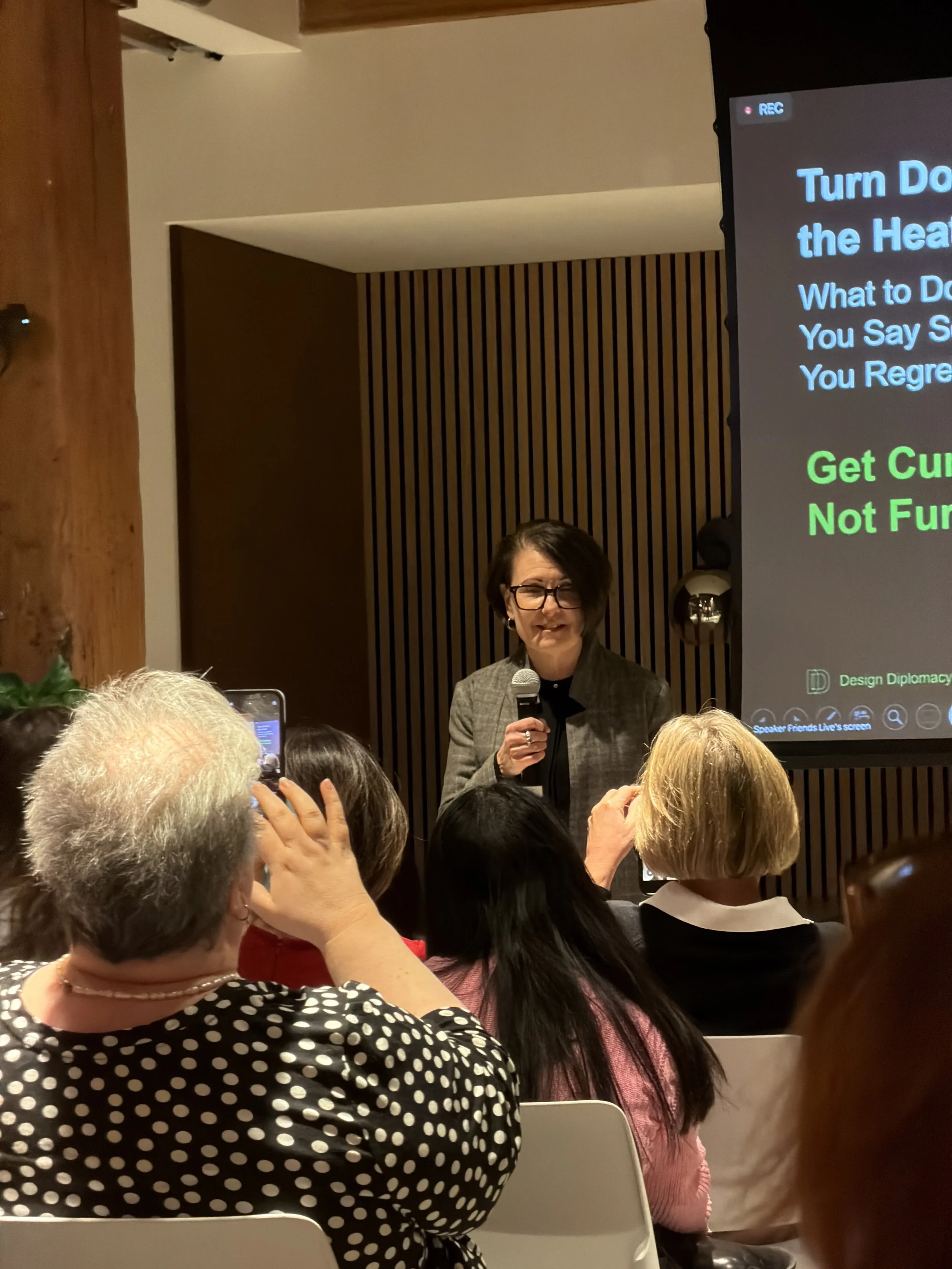
Last week I participated in an event that felt like a speaker marathon. The purpose was to test out new material and gain some footage for our personal ‘sizzle reel’. The big challenge? We had only 5 minutes on stage – or 28% of an average TED talk. The following is what I shared, originally titled What to Do Before You Say Something You Might Regret.
A few years ago, I was working with a leadership team that had been stuck for months. Every meeting felt tense. The conversations were polite, but you could always feel the frustration simmering.
One day, a leader finally snapped and said, “This is pointless. We talk and talk and nothing changes!”
Another person shot back, “That’s not fair. We are changing things—you just don’t notice!”
And boom. We had the makings of a full-blown conflict.
As I watched this unfold, I noticed something interesting.
These two people weren’t actually arguing about the same thing.
One was trying to protect her credibility—she didn’t want to look ineffective.
The other was trying to protect his effort—he didn’t want his work dismissed.
Same conversation. Two different experiences.
That moment changed how I see conflict—and it’s what I want to share with you today.
Quick show of hands: How many of you replay arguments in your head and think, “I should have said this…I should have done that…”
Yeah. Most of us.
Conflict is a universal part of life.
And yet we never learn how to work with it.
Here’s the big insight that changed everything for me:
Conflict occurs when something important to us feels threatened.
Not when people are bad.
Not when someone is being “difficult.”
But when something we deeply value feels at risk.
These could be things like:
Our competence.
Our autonomy.
Our status.
Our sense of belonging….or even our safety.
Just to name a few.
So when conflict erupts, it’s not random.
It’s protection.
And the REAL challenge is this:
If we don’t know what’s being protected—we can’t resolve the conflict.
(Although we most definitely can escalate it).
So before you say something you regret, pause and - you may have heard this saying before - get curious, not furious.
I’m going to give you the three moves that support curiosity in a heated situation:
The first is inquiry.
Inquiry is interrupting the story that your brain is telling you about the situation (our brain is fast—but not always accurate).
So instead of thinking: “Why is she being so unreasonable?!”
Try thinking: “What feels at risk for me right now?”
And instead of saying: “Stop being so dramatic!!”
Try saying: “Something just shifted here, what was it?”
Curiosity doesn’t make you weak. It makes you informed.
The second move is listening.
Of course, I don’t mean listening to yourself plan your great rebuttal.
I mean listening to the other person with an intent to truly understand them.
Here’s the thing: Understanding them does not mean you’re on your way towards agreeing with them.
But when people feel heard AND understood, they stop fighting for airtime.
That alone will begin to de-escalate the conflict.
Then comes the most powerful yet underused skill. The third move: reflection.
This is where you make the invisible visible.
For example, you could say:
“It sounds like we have a different idea of progress – what’s your perspective?” or
“I sense that you feel we should be further along by now – is that true?”
Again, this is not about conceding – it’s about clarifying.
And clarifying is calming.
Following your reflection with a new inquiry repeats the cycle and helps turn down the heat.
So here’s what I want you to remember, the next time you feel that urge…
… and your chest tightens.
… and your jaw clenches.
… and your brain starts building a case…
Don’t ask yourself: “How do I win this argument?”
Get curious and ask: “What am I trying to protect?”
Because when you get curious, you get choice - the choice to NOT say something you might regret later.
So, over the next week, try this just once.
Get curious—not furious.