
Speed Coaching
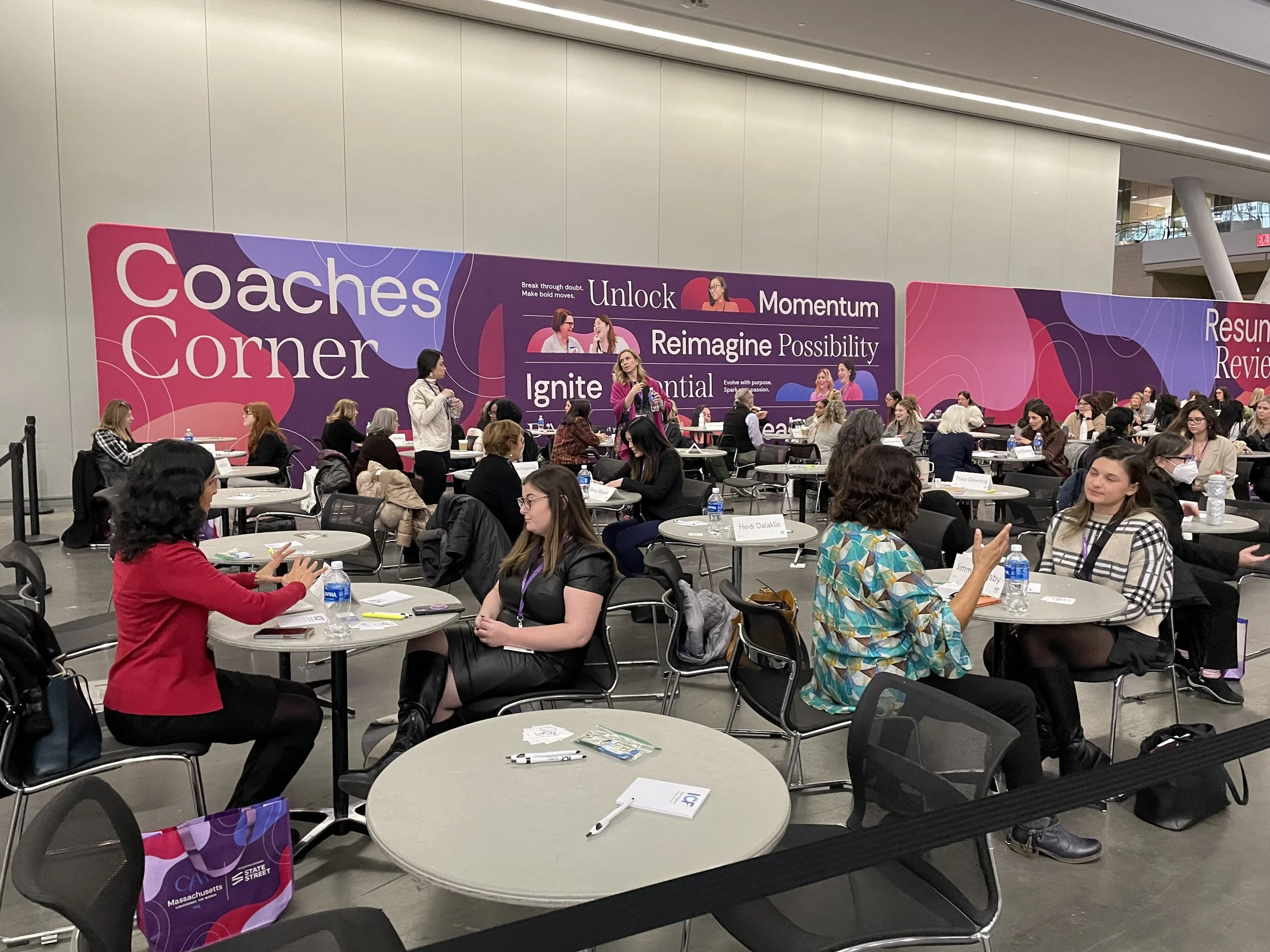
Last week was the twenty-first annual Massachusetts Conference for Women, an event that attracted 11,000 people to the Menino Convention Center in Boston. A regular feature on the enormous trade hall floor is the Coaches Corner, supported by the International Coaching Federation’s New England Chapter of which I am a member.
As one of this year’s volunteer coaches, I was assigned a two-hour shift during which I would coach walk-up attendees in 20-minute micro-sessions.
To be clear, I do not recommend this kind of speed coaching.
Coaching typically unfolds over time because its purpose is to guide the client to access and apply their own wisdom for making progress in their lives. Unlike mentoring or advising, coaching does not offer solutions or directives. It is discovery-driven.
And yet…even the briefest coaching conversation can yield results. Here’s what happened at my table:
In just 20 minutes, a healthcare executive who had rebuilt her life after losing everything and was resisting taking a lucrative next step in her career, was able to question the story she was telling herself that caring and commerce are mutually exclusive.
In just 20 minutes, a pharmaceutical operations leader who felt stuck in her career due to limited advancement opportunities in her current organization, was able to recognize several actionable paths for pursuing her love of learning while maintaining a level of recruitability in an uncertain job market.
In just 20 minutes, a recent college graduate who thought she needed to strategize every move in her budding career was able to consider that she didn’t need a five-year plan but could instead optimize her decision-making based on the opportunities directly in front of her.
I’m still amazed every time I witness the power of effective coaching – even when I’m the coach! Here’s what made each of those 20-minute conversations productive:
Being present for the person sitting in front of you, even when there’s a beehive of activity all around. Acknowledging our shared human messiness is one of the reasons why (per the NeuroLeadership Institute and others) AI will augment but never fully replace human coaches.
Quickly identifying the central topic that needs to be addressed, especially when there’s a lengthy or rambling prologue. It’s important to triage the information most relevant to the issue at hand (or, as we say, bottom line it).
Resisting the urge to fix or solve the issue for them. Instead, provide guidance through thoughtful questions to help them identify viable options. My knowledge of healthcare and pharma is limited, and it’s been years since I graduated college. As a former designer I support many leaders in the creative fields but industry expertise matters little in a coaching conversation.
Ending the conversation with a clear challenge to take one small action, experiment, or exploration. This is the starting point for all sustainable (vs. temporary) change.
Of course, that ending is where the value of a longer coaching relationship truly begins. It’s a partnership that supports iterative cycles of action, reflection, and learning. But you don’t need to be a coach to put these principles into practice. They are useful in any conversation where your goal is to support another person’s growth.
Even a 20-minute one.