
It was the end of a two-day retreat I had created and facilitated for 50 leaders of a large design firm. The highly-interactive program was focused on aligning around a strategic vision for the next decade and an eventual leadership transition.
I often think about facilitation as if it were a plane flight. You need to get airborne, then reach cruising altitude (prepared for some turbulence along the way), and eventually land smoothly.
Ending a workshop that spans multiple days calls for a landing that involves something more than an abrupt stop when time is up. If participants are expected to integrate and carry forward what was discussed, learned, or produced, the landing needs to be just as deliberate as the flight itself.
For the experience to stick I needed a way to do three things: stimulate personal reflection, reinforce the connections the leaders had made with each other (many for the first time) and provide structure for sharing highlights when they returned to their respective offices.
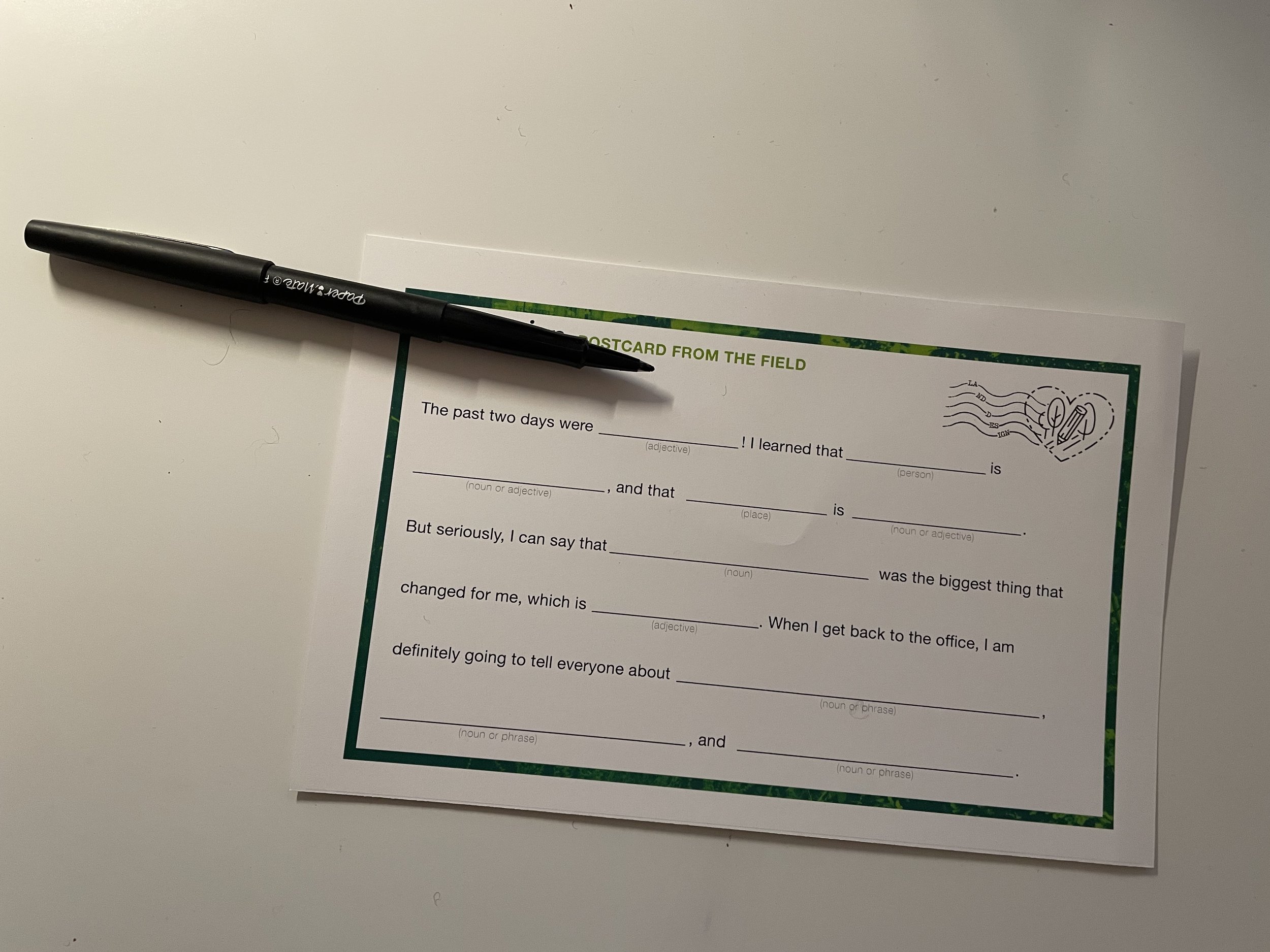
Thus Postcards from the Field was born!
As a closing activity, everyone received a large format card that prompted responses for creating a narrative about the following:
Connection: People I connected with and what I learned about them
Reflection: A personal insight
Transfer: What I will take back to my team or workplace
After about 10 minutes of writing, I asked that they bring their cards and their chairs to the back of the room where we formed a circle. One by one, participants read what they'd written. There were funny observations, unexpected connections, personal revelations, and a few thoughtful takeaways that people planned to bring back to their teams.
Everyone had the option to pass, but no one did. Even some of the quieter participants found something they wanted to share. The postcards seemed to give people just enough structure to make it easier to speak, without making the exercise feel overly scripted.
What struck me was how much this simple exercise accomplished. It gave participants a chance to reflect on what they'd experienced, but it also made the connections between them more tangible (and humorous!). And because everyone left with something tangible, the conversation had a chance to continue beyond the room.
We spend a lot of time thinking about how to get a group started, how to keep the energy going, and how to navigate tension and friction along the way. But the landing deserves just as much attention. Don't let the clock decide how your meeting ends. Design a closing that helps people make meaning of the experience, connect with one another, and carry something useful into whatever comes next.